This report was originally published in Dutch by het Papoeahuis. This residency was made possible in part by funding from the Stichting Amarte Fonds.
Sound often tells stories that aren’t always visible. Driven by this thought, I set off last May for West Papua, for an artist residency at the Alyakha Art Centre, located at lake Sentani.
As an ethnomusicologist and sound artist, I explore how sound can offer insight into the relationship between identity, culture, and nature. With my own roots in Suriname, India, and the Netherlands, I focus on the impact of Dutch colonial history on marginalized local communities, and how that resonates today. Truth be told, I felt a slight sense of shame when it was only through the documentary The Promise that I truly learned the history of this region. But the film stayed with me; it planted a seed that made me certain I had to go there myself, to pass that seed along to others through my own field.
During this residency, I didn't just want to collect sounds, but above all, listen to (and with) the people connected to the sound. These are voices that often don’t get the space to be heard. Over the course of five weeks, I collaborated with local artists and communities around Jayapura, lake Sentani, the Baliem Valley, Arfak Mountains, and the islands of Biak and Padeido.
Alyakha Art Centre, founded in 2019 by Irma Awoitauw and Markus Rumbino, is a very special institute. At its core, they encourage young people to explore their Papuan identity and cultural background through art. Since 2019, Alyakha Art Centre has hosted residencies and festivals, including The Khayouw (2019), Romiyae Phuklah (2023), Baku Konek(2024), Wali No (2025), and Khombouw (2026).
Over the years, Alyakha has invited renowned Papuan artists such as Dicky Takndare, Alberto Wanma, Agus Ohee, and Agus Ongge to act as mentors and create art alongside the young members of the collective Sanggar Nafas Danau Sentani (Breath of Lake Sentani) in the village of Yokiwa. These programs aren't just aimed at building artistic skills, but specifically at exploring and strengthening their cultural identity.
Irma and Markus’s dream is to grow Alyakha into a major center for the development and preservation of cultural knowledge. By maintaining a living archive of visual arts and music, they want to reinforce the region's identity while creating economic opportunities for local artists across West Papua.
During my stay, it became clear just how vital their role is. To many local youth, Irma and Markus aren't just artists and mentors, but family. When I asked if they wanted children of their own, they laughed and said, “We already have enough children at the moment.”
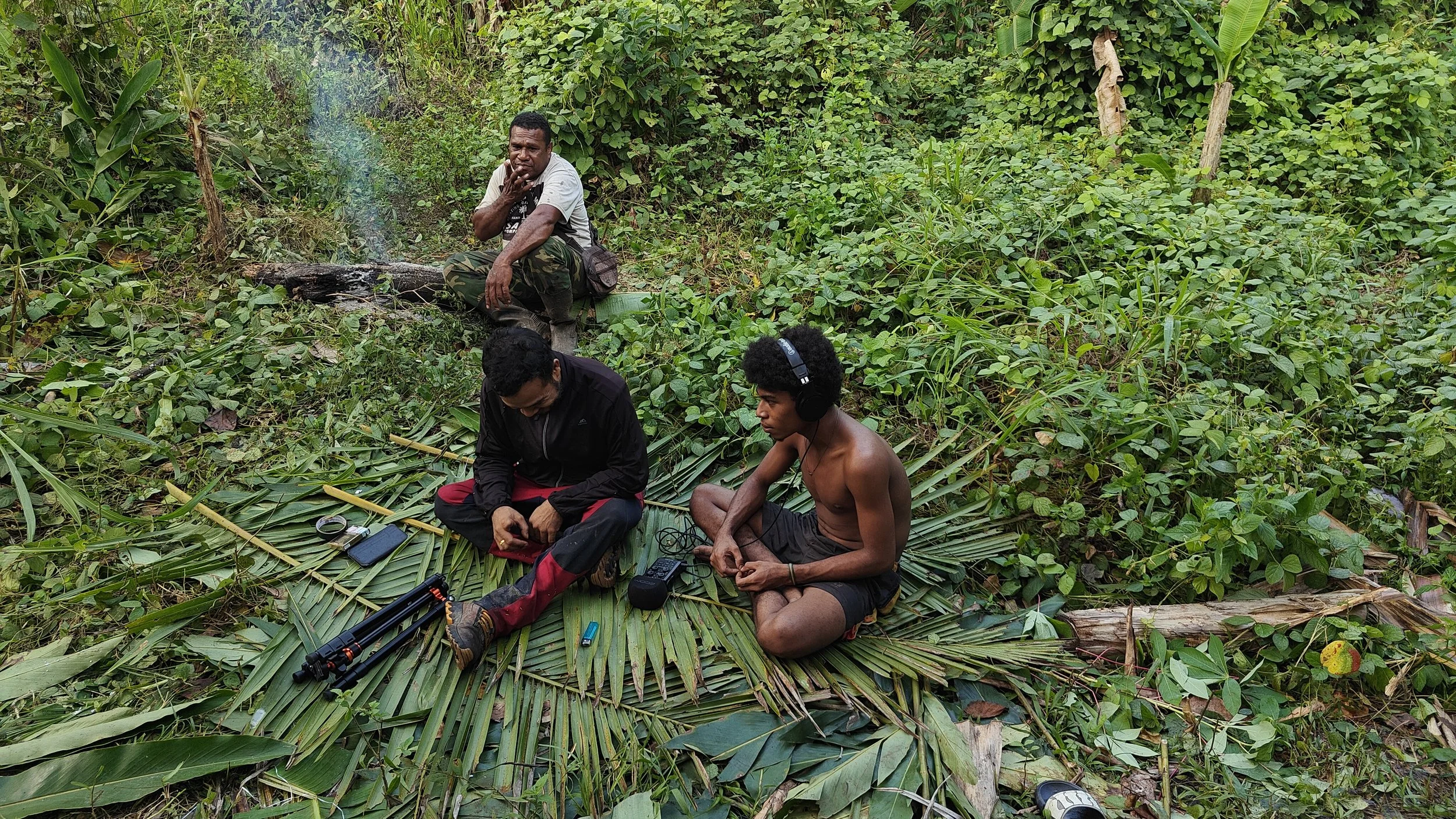
I felt this deep commitment throughout the residency. Whenever we went into the field to record, kids and young people would always join us. They were curious about the gear and eager to be part of the process. One of them took my camera to film, while another got to use Markus's microphone. They were open to everything and visibly excited to explore. After recording, we’d sit around the table together and listen to the sounds we’d captured at dawn. Together with the village elders, we’d always manage to identify the different bird species using their names in the Sentani language. Once again, it reminded me that a project isn't just about the final output, but about the process itself, and all the experiences and people who become part of the journey along the way.
A pivotal moment happened during our night in the sacred forest near Lake Sentani, which the local community calls Rhuna. This place holds deep spiritual significance and was where many rituals took place prior to missionary activity. At the same time, the area is increasingly impacted by activities like gold mining and logging. One of the kids who joined us mentioned he barely recognized the forest anymore. Since his last visit, a huge portion of it had already disappeared.
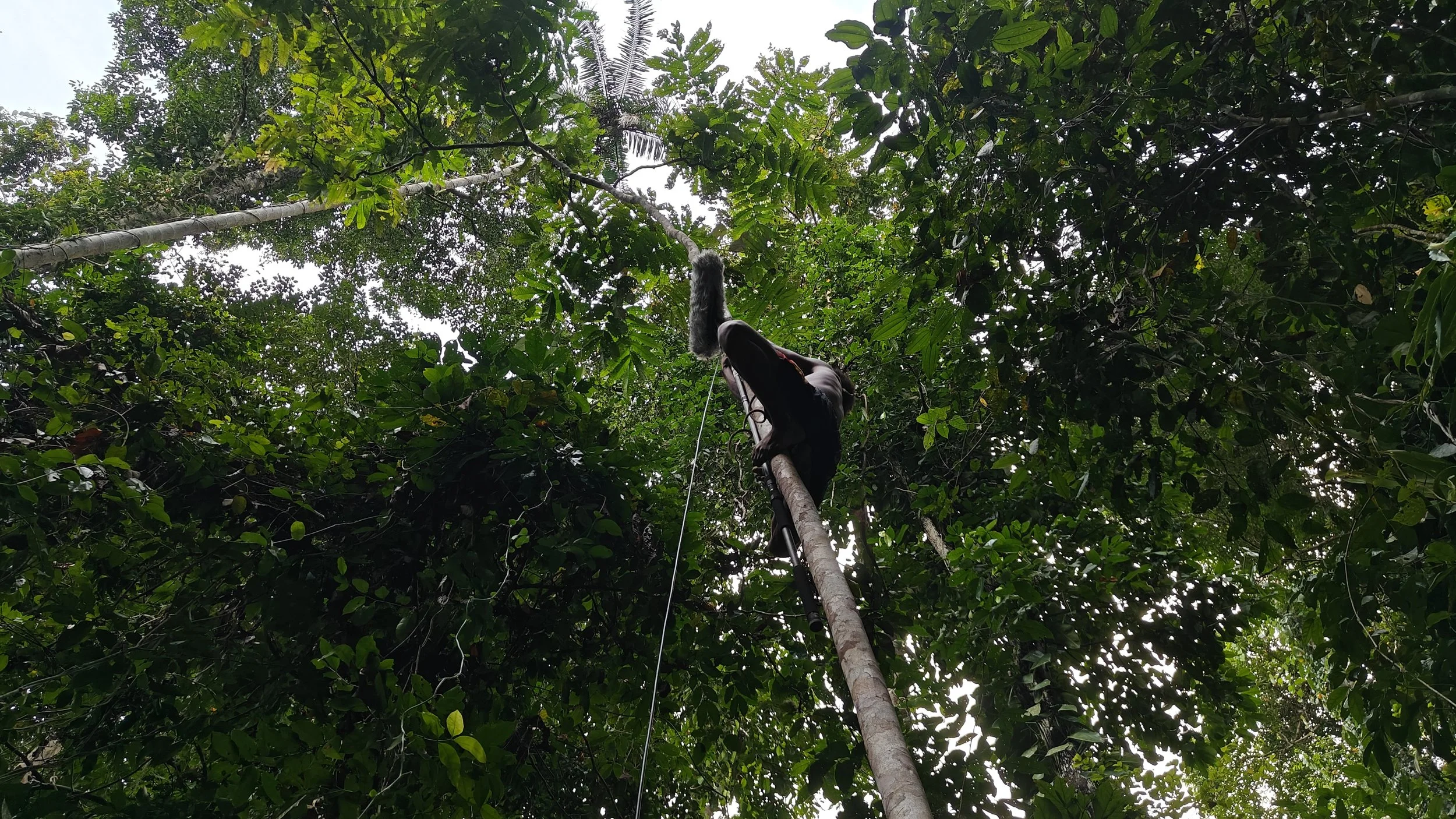
During this experience, we searched for the sound of the cendrawasih (bird-of-paradise), which holds major cultural importance as a symbol of the Ondoafi, the community's traditional leader. Coming from my background, I tried to get as clean a recording as possible, free of distracting background noise. The others saw it differently. They pointed out that the sound of a low-flying airplane passing over the forest was part of today's reality.
A week later around 5 AM, we were at a mining site in another key forest, called Hanggau by the local community. We recorded the way the landscape responds to human presence and extractive activities. As the sun slowly rose, we listened to machines blending into the forest’s soundscape. It was a confronting experience. The transformation of the landscape is literally audible.
The same forest can carry vastly different meanings. To a local, a place of life and spirituality; to an outsider, a site of economic opportunity or colonial greed. The sound within a forest takes on deeper meaning once you understand the context behind it.
All these experiences shifted the way I work and formed the foundation for a larger project: Living Forest. This upcoming sound installation brings together new field recordings, created in close collaboration with local artists, with historical archival materials from the 1960s. The work explores how one forest can hold contrasting perspectives, and how these stories converge in a single environment.
Together with Markus, I also traveled to the highlands of the Baliem Valley. There, I experienced how listening to nature, like the call of the Alikine cicada, which can bring an entire village to silence, is seamlessly woven into daily life. That time in the highlands left a profound mark on me and changed how I listen. It challenged me not to listen from my own perspective, but through the lived experience of the community itself. Read the full account here on Substack.
I could write a book series about my experiences after more than a month in West Papua. It's hard to sum up a period filled with so many contrasts in just a few words. I experienced the overwhelming beauty of nature and the warmth of the people I met. At the same time, I also felt what it's like to be constantly aware of control, uncertainty, and not always knowing who you can fully trust.
The most confronting realization was that, ultimately, I would be going back home. For the people I met, this is home, along with all the challenges and uncertainties that come with it. This experience hasn't just changed how I work as an artist and researcher; it’s made me far more aware of the responsibility that comes with telling stories that aren't mine. It’s an experience I won't easily let go of, and it will undoubtedly keep shaping my future work. And who knows, maybe I’ll be back sooner than I think.